
Hospitals are, by nature, high-stakes places. People often arrive feeling anxious, vulnerable or uncertain about what comes next. Physicians and care teams help patients feel seen and supported, but they’re not the only ones shaping the experience. The environment also plays a crucial role.
From the time a patient walks through the door to when they leave, design choices influence how comfortable they feel, how they perceive the quality of care they’re receiving, and whether they’d choose to come back in the future.
A good place to start when building a patient environment that people want to be in: the systems your healthcare facility uses every day.
Does Your Hospital Equipment Make People Feel Seen?
For many patients, going in for an MR exam or a CT scan can be stressful before the procedure even starts. There’s fear of the unknown, concerns about confined spaces, loud noises or simply the discomfort of lying still while a machine does its work.
Physicians and technologists can help ease those nerves through clear communication and reassurance. The equipment design can either reinforce that calmness or completely undo it.
High sound levels, narrow bores or equipment that feels physically restrictive can heighten anxiety, especially for claustrophobic patients, pediatric populations or patients with larger body sizes. On the other hand, investing in imaging systems designed with patient comfort in mind, with wider bores, quieter operation and accommodations for a broader range of body types, sends a clear message: you belong here, and we thought about your experience.
Mobile workflows add another layer of reassurance. When healthcare workers can use tablets and remote controls to stay close to a patient’s side, rather than disappearing behind a console, it keeps human connection intact. Being physically present to answer questions and explain what’s happening in real time can make all the difference during an already stressful moment.
Is Your Hospital Equipment Built for Quality and Speed?
When a patient is anxious, time seems to stretch for that person. Long waits and extended procedures amplify stress and discomfort.
While wait times are one part of the equation, the speed and efficiency of the scan also contribute to the patient experience. Smart equipment design helps streamline the process from start to finish.
Consider patient positioning. Systems that can automatically adjust to a patient’s body reduce setup time and eliminate unnecessary repositioning. That means less time spent on the table and fewer moments of uncertainty where the patient is wondering whether they’re “doing it right.”
AI-powered tools make a meaningful impact, too. Technologies that boost signal strength and image resolution allow clinicians to capture high-quality images faster, without sacrificing clarity or diagnostic confidence. Faster scans reduce the chance of patient movement, which in turn lowers the likelihood of rescans. For patients, that means less time in the machine and fewer repeat appointments. For providers, it means more efficient workflows and more reliable results that support better patient outcomes.
Does Your Equipment Live in a Healing Environment?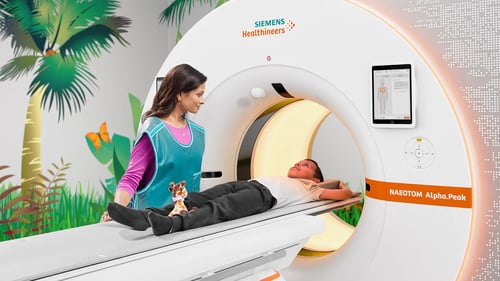 The system itself is only part of the story. The environment surrounding it plays a powerful role in shaping how patients feel during a scan.
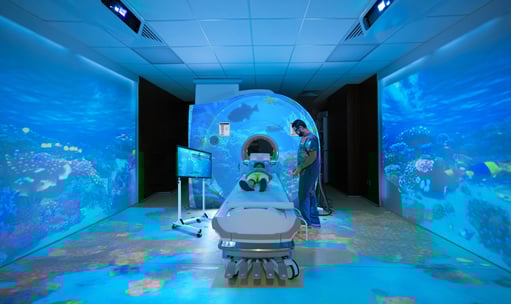
Lighting, for example, can shift the mood of a space. Adjustable, mood-enhancing lighting can wash a room in soothing colors, helping patients relax before and during a procedure. Ceiling-mounted skylights or digital displays that show artwork or nature scenes give patients something calming to focus on, which can be an especially effective tool in imaging suites where patients lie flat and look up.
Pediatric areas benefit even more from intentional design. Wall coverings featuring oceans, outer space, or playful scenes can turn a clinical room into something closer to an adventure, keeping young patients distracted and at ease during procedures.
Soundscapes are another subtle but impactful detail. Nature sounds, like flowing water or gentle forest ambiance, can soften the clinical feel of an imaging room and help patients feel more grounded, as if they’re somewhere familiar rather than inside a hospital.
Thoughtful spatial design, meanwhile, brings everything together. Flexible, family-friendly furniture that can be easily rearranged helps accommodate loved ones who want to stay close. And hiding medical equipment and supplies behind clinical wall panels reduces visual clutter.
Healthcare That Feels Human
Every design choice discussed here points to one core goal: helping patients feel safe, seen, and more in control of their care.
That goal matters more and more as hospitals serve increasingly diverse populations. Patients arrive with different body types, sensory sensitivities, cultural backgrounds, mobility needs and comfort levels in medical settings. When equipment is loud, restrictive, or inflexible, it can unintentionally signal that patient care wasn’t designed with them in mind. But when environments prioritize comfort, adaptability, and choice, they communicate something powerful: you belong here.
Cassling works alongside healthcare organizations to create patient environments that balance clinical performance with human-centered design. From state-of-the-art imaging technology to comfort-focused room solutions, Cassling helps hospitals deliver care that performs at a high level and feels better for the people receiving it.
Because when patients feel respected and empowered, everyone benefits. And that’s how you build a patient environment people actually want to be in.
Contact us today to learn more.




Comments