
 Helium has become one of the most unpredictable variables in MRI operations.
If you’ve spent any amount of time in imaging, you’ve probably encountered price spikes, a delivery delay or a quench pipe scare. That’s when you realize how much that single resource can affect your day, your budget and your long‑term planning.
As helium‑free systems enter the market, including innovations from Siemens Healthineers, healthcare leaders have begun thinking about what it means to move away from systems that require an unpredictable and increasingly expensive resource.
In this blog, learn more about the realities of helium use in MRI, why it’s gaining traction and, because many imaging teams want to know what this means in real‑world purchasing terms, the solutions available to you today.
Why do MRI Scanners Require Helium?
Helium, MRI’s “liquid gold,” is a multifaced substance that’s exceptionally valuable for a number of reasons:
- No reactions. Due to its anatomical structure and nonflammable traits, helium does not catch fire, react with other chemicals or even bond with elements.
- Extremely low boiling point. Helium turns to liquid at a temperature of -269C, which is close to absolute zero; no other element does this.
- Smallest atom. Helium atoms are the smallest in the periodic table. Because they’re so small, they slip through microscopic spaces easily. This is also why engineers use helium to test for dangerous leaks in rocket engines and gas pipes.
At the heart of an MRI machine lie superconducting coils that generate a powerful magnetic field, and extreme cooling with liquid helium is essential for this operation. Liquid helium is the only practical coolant able to rid metals of their electrical resistance, enabling them to generate stable magnetic fields. Without helium, the MRI’s magnet loses superconductivity and collapses.
The Challenge with Helium
You’re probably thinking, “If helium is so effective, why move away from it?”
Traditional MRI scanners rely on roughly 2,000 liters of liquid helium to achieve high-quality images and keep their magnets superconducting and stable.
The challenge is that helium is scarce on Earth despite its abundance in space. It’s produced by the slow geological decay of various radioactive elements deep in the Earth’s crust and either accumulates in rocks or in pockets of natural gas, most notably found in the United States, Qatar and Algeria. We only get access to it through volcanic activity or complex separation techniques.
Since helium is a finite resource, every refill adds environmental strain and comes at a significant cost to a facility. By using less than 1% of traditional volumes, we’re dramatically reducing its rapid consumption.
How Helium-Free Systems are Making an Impact
Helium‑free (or low-helium) systems use conduction‑cooled magnets that require 0-20 liters of helium sealed inside the magnet instead of 1,500+ liters in a liquid helium bath.
But, how?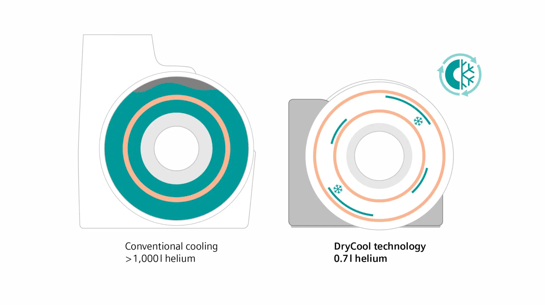
Siemens Healthineers’s DryCool Technology is one of the clearest examples of how manufacturers are answering that question. DryCool replaces the traditional liquid helium bath with a conduction‑cooled system supported by:
- No helium deliveries. Traditional magnets lose helium over time and require periodic refills. DryCool magnets have a sealed helium reservoir containing only 0.7 liters, which means these scanners are set for life.
- No quench pipe. Because there’s no large helium bath to vent, DryCool magnets don’t require a quench pipe. This simplifies siting and reduces construction costs.
- Lighter, more flexible installation. Without a heavy cryogen tank, DryCool magnets weigh less and can be installed in spaces that previously couldn’t support MRI.
- More predictable uptime. No cryogen deliveries means fewer interruptions.
As imaging teams explore what helium‑free MRI looks like in practice, it’s helpful to understand how this technology shows up in real systems currently available on the market. Siemens Healthineers has incorporated DryCool Technology into several of its MRI scanners.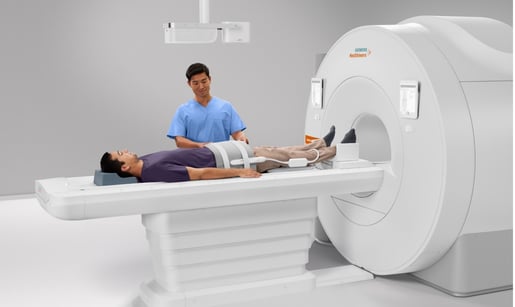
MAGNETOM Flow. Platform: The first fully scalable 70cm system, the MAGNETOM Flow. Platform is Siemens Healthineers's next-generation of 1.5T MRI. With no quench pipe and an ultra-compact footprint of only 25m1, MAGNETOM Flow. Platform empowers healthcare providers to meet the increasing demand for MRI.
MAGNETOM Flow.Ace: The first fully scalable 60cm platform and part of the next generation 1.5T MRI, the MAGNETOM Flow.Ace is built to adapt as business needs change. In addition to DryCool technology, the system provides annual energy savings of 30%2, achieved through its unique smart system timer and Eco Power mode.
MAGNETOM Free.Max: The world's first 80cm bore, the 0.55T MAGNETOM Free.Max MRI excels in image quality and leverages the full potential of digital power for the utmost in diagnostic quality. With DryCool technology, it provides a helium-free infrastructure and removes siting obstacles.
MAGNETOM Free.Star: A 60cm bore scanner, the Free.Star operates at 0.55T and is the smallest, most lightweight whole-body MRI system ever from Siemens Healthineers. Equipped with DryCool technology, less than 1L of liquid helium and no quench pipe, it's a virtually helium-free scanner.
In many ways, helium free MRI mirrors the intent behind the Rural Health Transformation Program and its emphasis on smarter infrastructure investments, predictable operating costs and sustainable technology adoption. Helium free MRI, supported by innovations like DryCool Technology, fits naturally into that framework by removing one of the most volatile and infrastructure heavy components of MRI operations.
The Future of Helium-Free Imaging Systems
Many high-field 3T and 7T MR scanners still require large helium baths to achieve the performance those ultra-powerful environments demand. And many hospitals have infrastructure already built around traditional MRIs, so making a transition to helium-free is neither practical nor necessary.
But helium-free systems are taking the spotlight as they begin solving many day-to-day challenges that MRI technologists are tired of, including unpredictable helium costs, quench pipe-related risks and ongoing maintenance of their systems.
The future isn’t “all or nothing.” A hybrid approach is often the sweet spot for building an MRI fleet that meets high‑performance needs yet still captures the financial, operational and sustainability gains helium‑free systems bring.
If you’re ready to see what that looks like in your practice, explore our helium‑free MRI portfolio and let us help you find the systems that fit your organization’s strategy.
1 Data on file. Values based on preliminary measurements. Results were achieved by Siemens Healthineers using both standard and optional features. There can be no ‘typical’ hospital setting (case mix, system type, etc.) and so results by users may vary with no guarantee that the same results can be achieved.
2 Compared to previous generations. Data on file. Values based on preliminary measurements. Results were achieved by Siemens Healthineers using both standard and optional features. There can be no ‘typical’ hospital setting (case mix, system type, etc.) and so results by users may vary with no guarantee that the same results can be achieved.




Comments